

Why Do Jowls Form? A Doctor's Guide to Lower-Face Ageing and Treatment Options in Nottingham
One of the most common things I hear in clinic is: 'My jawline just does not look as sharp as it used to.' Sometimes the change is subtle. Other times, patients feel as though it has appeared almost overnight in photographs or from certain angles.
Jowls are a very normal part of facial ageing. They are not caused by one single problem, and that is important, because the best way to improve them depends on what is changing underneath the skin as well as what we can see on the surface.
At Your Beauty Doctor in Nottingham, I look at the whole lower face before recommending anything. For one person, the main issue may be skin laxity. For another, it may be loss of structural support around the cheeks, chin or jaw. Often, it is a combination.
What are jowls?
Jowls are the areas of soft tissue that begin to sit lower along the jawline, usually between the chin and the angle of the jaw. They can make the lower face look heavier or less defined, even when your weight has not changed.
They are often most noticeable when the smooth line of the jaw starts to look interrupted, or when a small hollow develops just in front of the jowl. That hollow is sometimes called the pre-jowl area.
Why do jowls form as we age?
Facial ageing happens at several levels at the same time. That is why simply 'tightening the skin' or 'adding filler' is not automatically the answer for everyone.
1. Collagen and elastin gradually reduce
As we get older, the skin produces less of the structural proteins that help it feel firm and resilient. The skin can become thinner and less able to spring back, so the lower face is more likely to show laxity.
2. Facial fat changes position
The fat compartments that give the face soft support also change with age. Some areas lose volume while others descend. This can make the cheeks look flatter and allow more weight to sit around the lower face.
3. Bone support changes too
We also lose some bony support as we age, particularly around the jaw and mid-face. These changes can alter the framework that the overlying tissues rest on.
4. Genetics, sun exposure and weight change all play a part
Some people naturally have a softer jawline from a young age. Repeated sun exposure can accelerate loss of elasticity, while significant weight loss can sometimes reveal skin laxity that was less obvious before.
Is a soft jawline always the same as jowls?
No. A naturally soft jawline, a recessed chin, fullness under the chin and true age-related jowling can all create a similar impression from the front or side, but they are different problems.
This is why a proper facial assessment matters. Treating the wrong structure can add heaviness rather than improve definition.
What can help improve the appearance of jowls?
There is no universal 'best jowl treatment'. In clinic, we decide what to treat only after working out whether the main issue is skin quality, laxity, loss of support, facial shape, or a mixture.
Skin tightening when laxity is the main concern
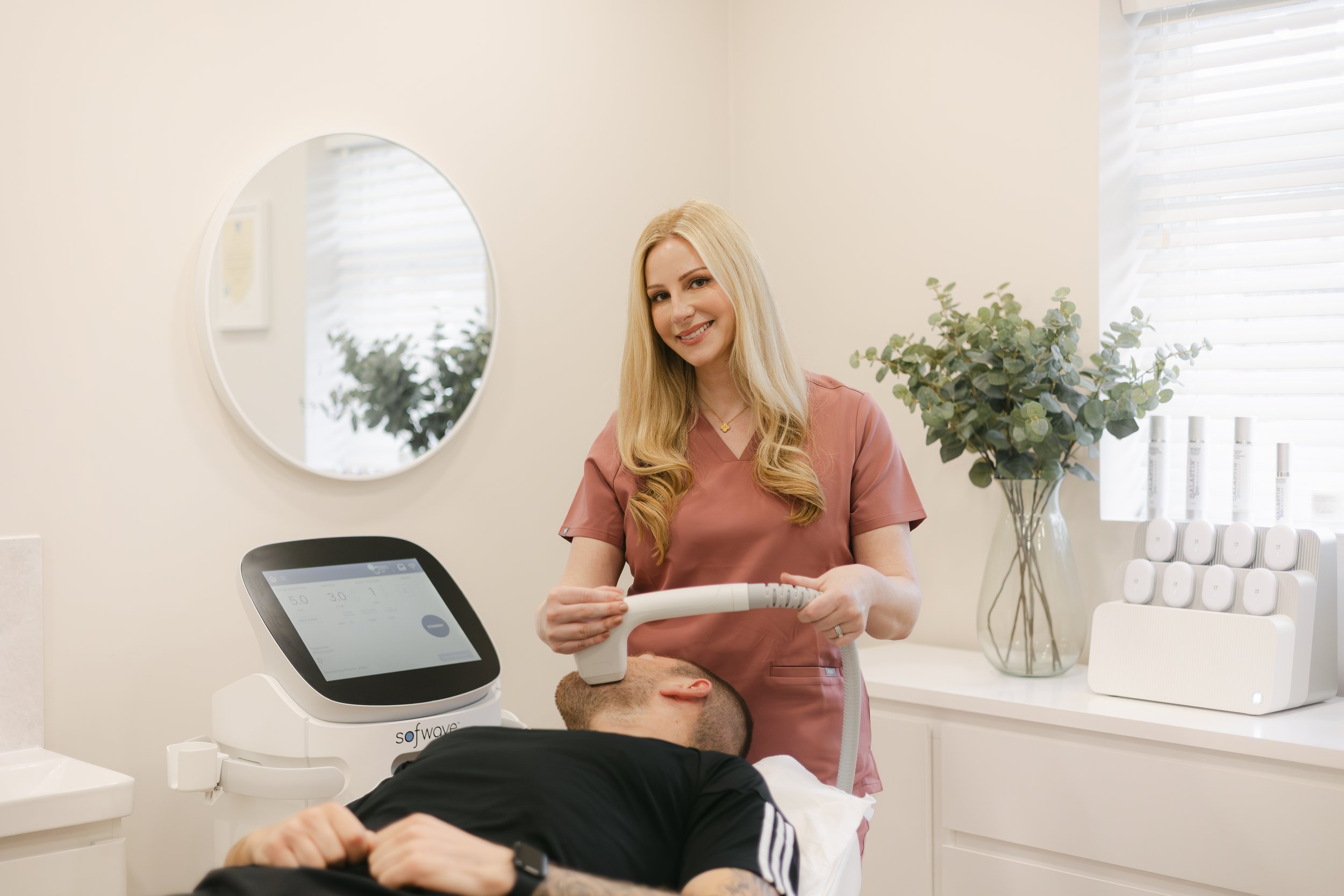
For patients whose skin has become looser but who do not need extra volume, a collagen-stimulating skin-tightening treatment may be considered. At YBD, Sofwave ultrasound skin tightening is one option we use for suitable patients who want to improve firmness without surgery.
The aim is not to create a different jawline overnight. It is to support gradual collagen renewal and improve the quality and firmness of the skin over time.
Collagen stimulation when there is broader facial ageing
Where there is a combination of reduced skin quality and more general loss of facial support, a biostimulatory injectable such as Sculptra may sometimes form part of a wider plan. Sculptra is different from a traditional hyaluronic acid filler because its main role is to stimulate collagen gradually rather than simply fill one line.
Structural filler when the jaw or chin needs support
In some faces, the appearance of a jowl is exaggerated by a weak chin, loss of jawline definition or a dip in front of the jowl. Carefully placed chin and jawline filler can sometimes restore balance and make the lower-face outline look cleaner.
This is not the same as putting filler directly into every sagging area. Good lower-face filler treatment is about proportion and support, not simply adding volume.
Can filler make jowls worse?
It can if it is used in the wrong place or in too much volume. A face that already feels heavy through the lower third does not usually benefit from indiscriminate filling.
That is why my approach is conservative. Sometimes the best plan is skin tightening. Sometimes it is structural support. Sometimes it is a combination, and sometimes the most appropriate advice is to do very little.
What about marionette lines and the corners of the mouth?
Jowls often sit alongside other lower-face changes, including marionette lines and a downturned appearance at the corners of the mouth. These features are related, but they are not identical. A treatment plan should look at how the cheek, mouth, chin and jaw work together rather than chasing each individual line.
Can skincare get rid of jowls?
Skincare is still important because healthy skin behaves better, looks brighter and is better protected from further sun damage. Retinoids, antioxidants and daily SPF can support long-term skin quality when appropriate for your skin.
What skincare cannot do is rebuild lost bone or reposition facial fat. If the concern is structural, creams alone will have limitations.
What I look for during a lower-face consultation
When I assess jowls, I am not just looking at the bit you want to change. I look at cheek support, chin projection, jawline shape, skin quality, facial movement, asymmetry and any previous filler. I also want to understand what bothers you and what you would consider a good result.
YBD's wider philosophy is explained in our doctor-led guide to ageing well in your 30s. The same principle applies at every age: the right treatment is the one that fits your face, rather than the treatment that happens to be trending.
The aim is a fresher, better-supported lower face
For most of my patients, the goal is not a razor-sharp jawline or a dramatic transformation. It is to look a little more rested, supported and like yourself again.
If your lower face has changed and you are unsure whether the issue is skin laxity, volume loss or facial structure, a consultation at our Nottingham clinic is the best place to start. We can assess what is actually happening and talk through the options without pressure to proceed.
Frequently asked questions
What causes jowls?
Jowls usually develop because several age-related changes happen together, including reduced collagen and elastin, changes in facial fat, loss of bony support and skin laxity. Genetics, sun exposure and weight change can also affect how noticeable they become.
Can you get rid of jowls without surgery?
Non-surgical treatments may improve the appearance of jowls in suitable patients, but the right option depends on the cause. Skin tightening, collagen stimulation or carefully placed structural filler may help, while more advanced laxity may require a surgical opinion for the most significant change.
Can jawline filler help jowls?
Jawline or chin filler can sometimes improve the appearance of jowls by restoring structural support or smoothing a pre-jowl hollow. It is not suitable for every face, and adding too much filler to a heavy lower face can be counterproductive.
Does Sofwave help jowls?
Sofwave may be considered when skin laxity is contributing to a softer jawline. It works by stimulating collagen within the skin, so results develop gradually and suitability is assessed during consultation.
At what age do jowls start to appear?
There is no fixed age. Some people notice early lower-face laxity in their 30s or 40s, while others keep a defined jawline much longer. Genetics, facial structure, sun exposure, skin quality and weight changes all influence when jowls become visible.
Can skincare prevent jowls?
Good skincare and daily sun protection can support skin quality and help reduce avoidable collagen damage, but skincare cannot replace lost facial structure or fully prevent age-related tissue changes.
